SWAFFHAM IS A SMALL town in Norfolk, west of Norwich. Two of its former inhabitants enriched their lives by digging. One of them is more widely known than the other. The lesser known one was a pedlar, who lived in the 15th century and was most probably called John Chapman.
The pedlar had a dream in which he was told to go to London Bridge to receive some good news. He ignored it at first but after it had recurred several times, he set off for London with his pack on his back and his dog at his side. When he reached London Bridge, he found nothing, and received no good news. After a few days of lurking on the bridge, one of the shopkeepers on that ancient crossing of the Thames asked him what he was doing. The pedlar related his dream and the shopkeeper replied:
“How foolish you are. You should not believe such dreams. Why, only last night I dreamt that I should go to Swaffham in Norfolk and dig under an apple tree where a pot of treasure was buried. Do you think I should believe that? Of course not, my friend. If I were you, I would go home and ignore such dreams.”
Hearing this, the pedlar realised that he had just heard the good news for which he had come to search.
Back in Swaffham, the pedlar dug beneath his apple tree and discovered a pot of gold. After emptying the pot, he added it to the wares he was peddling. The pot had a label attached. As the pedlar was illiterate, he asked a local priest to read it to him. The words on the pot said:
“Beneath me, thou shalt find even greater riches.”
The pedlar returned to his apple tree and began digging again. Lo and behold, he discovered another pot filled with gold, far more than in the first.
Whether or not this tale is true, there was a John Chapman in Swaffham, who lived in the town and was a church warden in 1462, at the time when the parish church was being rebuilt. He donated a huge amount of money towards building both the church’s tower and its north aisle.
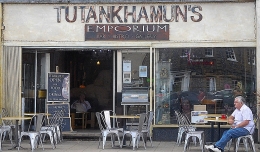
The existence of the digging pedlar and his story might possibly be questioned by sceptics, but that of Swaffham’s other famous digger is beyond doubt. When we visited Swaffham recently, it was hard to miss seeing an eccentric looking café-cum-curio shop called ‘Tutankhamun’s Emporium’, with the subtitle ‘Bar, Bistro, Gallery’. In addition to a Russian restaurant called Rasputin, the choice of an Ancient Egyptian’s name for a café in Norfolk struck me as odd until we visited the town’s small museum.
Samuel John Carter (1835-1892), a noted Victorian animal artist and illustrator, was born in Swaffham. After studying at the Royal Academy, Samuel lived both in London and Swaffham. He married Martha Joyce Sands, born in Swaffham, and the couple produced 11 children, the youngest of whom was named Howard. They lived most of the time in London, where Howard was born (in Kensington). Howard, a sickly youngster. Was sent from London to live with Samuel’s sisters in Swaffham.
Howard Carter (1874-1939) spent most of his childhood in and around Swaffham. Like his father, Howard had great artistic talent. He used to visit local country houses with his father when the latter was up in Norfolk. One of these was Didlington Hall near Swaffham. Its owner, William Amhurst Tyssen-Amhurst (1835-1909), an MP, was a great collector of books and antiquities. The collection included many Ancient Egyptian artefacts, which fascinated young Howard. In 1890, the Amhursts were visited by Percy Newberry (1869-1949), who worked for the Egypt Exploration Fund. Discovering Howard’s talents as an artist and interest in history, Newberry invited him to work at the British Museum, copying tomb and other wall paintings that had been discovered in Egypt. Soon, Carter was sent out to Egypt on archaeological expeditions to work alongside the archaeologists. In 1922, Howard discovered the tomb that contained the remains of the boy king (pharaoh) Tutankhamun (c1341-c1323 BC). This discovery brought great fame to Howard: a digger brought up in Swaffham.
The local museum in Swaffham has displays relating to Carter and Tutankhamun. Both might be flattered if they were to learn that a small town in Norfolk, many thousands of miles away from the River Nile, has a café named after the short-lived pharaoh. As for the pedlar, the town is full of images of him trudging along with a pack on his back. In the parish church, which he might well have helped to finance, there are woodcarvings of him and his dog.
We visited Swaffham whilst travelling around Norfolk because we had read that it has an attractive parish church and an unusual 18th century circular market cross. However, learning about the pedlar and the archaeologist, two famous diggers, were unexpected bonuses for us.



 yamey
yamey 