
Laura Knight and a portrait of a woman from India

APART FROM TEMPORARY exhibitions, the Royal Academy of Arts (‘RA’) in London’s Piccadilly has a permanent collection of works by its academicians. Amongst these pictures, there is a particularly fine painting by David Hockney. However, what caught my attention when I visited the RA today, 21 February 2026, is an unfinished portrait by the artist Dame Laura Knight (1877-1970). The sitter was Vijaya Lakshmi Pandit (1900-1990), who was born in Allahabad (now Prayagraj), and died in Dehradun.
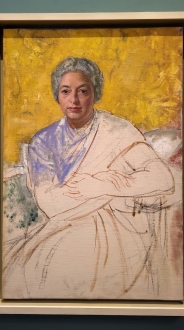
vijaya Lakshmi Pandit by Laura Knight

Vijaya’s brother was Jawaharlal Nehru (1889–1964). She was active in the fight for India’s independence, and was imprisoned twice by the British. After India became independent in 1947, Vijaya had several important roles, including (to mention but a few of her appointments): India’s ambassador to the Soviet Union, India’s High Commissioner to the UK, the first female President of the United Nations General Assembly, Governor of Maharashtra, and Member of India’s Lok Sabha.

Laura Knight met Vijaya in London during the late 1950s when she was high Commissioner. As already mentioned, the portrait is unfinished. In an article (https://pooleyville.city/articles/laura-knight-a-panoramic-view) about Knight, Ellie M Brown, noted that because her portrait of Vijaya was left unfinished:

“… we’re left with the clearest sense of how Knight worked as an artist. Beneath the vivid colours that capture the dignity, femininity and strength of her subject, we see the loose, free-handed brushstrokes that plot out the foundations of the final piece.”

I wonder why the painting was never finished. Was it because her subject was too busy for many sittings.? Who knows? It was interesting seeing this portrait of an Indian person because we had just viewed the RA’s exhibition of works by Indian artists, “Mrinalini Mukherjee and her Circle”, about which I will write another time.

No arms and legs but she was a competent painter of portraits

THE EXHIBITION WE saw today (the 3rd of June 2024) at London’s Tate Britain exceeded our expectations. Called “Now You See Us”, it consists of about 150 artworks created by over 100 women, working between the years 1520 and 1920. Apart from their gender, these artists shared at least one other thing in common: they were professional artists who worked in Britain, rather than talented amateurs. The earliest works on display are by women working in the Tudor Courts during the 16th century. They include Susanna Horenbout (1503–1554) and Levina Teerlinc (c.1510s–1576), some of whose exquisite paintings can be seen in the exhibition.

There were too many artists to be able to describe them all in this short essay. Some of them (for example: Angelica Kauffman, Artemisia Gentileschi, Mary Beale, Mary Moser, Laura Knight, Julia Margaret Cameron, and Elizabeth Forbes) are now well-known, but others whose works are exhibited are somewhat obscure. One notable artist, Élisabeth Vigée Le Brun (1755-1842), who lived (and painted a little) in England for about three years, is not exhibited in the show, which is a pity because from what I have seen of her work (at Ickworth House in Suffolk), she was a highly competent artist. Next, I will highlight several things that particularly interested me in this superb exhibition.

There are several small paintings created on sheets of ivory. They reminded me of the glass paintings I have seen in India. One of these is a beautifully executed self-portrait by Sarah Biffin (1784-1850). She was born without arms or legs, yet learned to sew, write, and paint using her mouth. Early in her career, she worked at country fairs, where people used to pay to watch her draw and paint. Later, she established herself as a professional portraitist.

There were three photographs by the Victorian photographer, Julia Margaret Cameron, about whom I have written a short book. I am glad that her works are included in the exhibition because her skill was creating painterly works of art, rather than accurate images, with photography. Here work was greatly admired by the pre-Raphaelites.

I was interested to see a painting by Frances Reynolds (1729-1807), who was the sister of the famous artist Sir Joshua Reynolds. Although the painting is not a great work of art, its presence in the exhibition exemplifies the situation for women artists before they were first admitted to art schools in the second half of the 18th century. Before that time, several of the artists, whose work is on display, had to learn to paint from male artists in their family – fathers, husbands, and so on.

For a very personal reason, I was interested to see a painting by the poet and painter Anne Killigrew (1660-1685). Her father was the playwright Henry Killigrew (1613-1700). The reason that this Killigrew family is of interest to me is that their coat of arms includes the double-headed eagle, indicating the family’s connection with the mediaeval Earls of Cornwall. Sadly, Anne, whose works are attractive, died young following a smallpox infection.

One room of the exhibition contained works by women artists working in the Victorian era. These, often sentimental, works did not appeal to me. However, the final room, which contains works created in the first two decades of the 20th century, is spectacular. Many of the exhibits in this room demonstrate how artists were abandoning tradition, and exploring new techniques. This period coincided with the gradual improvement in women’s rights in Britain.

The exhibition continues until the 13th of October 2024, and is well worth visiting.