
What the Dickens? David Copperfield on the Isle of Wight

BY THE END OF the last Ice Age (which occurred 1800 to 8000 years ago approximately), there was a huge landslip on the south coast of the Isle of Wight (‘IOW’). This resulted in the formation of an almost level strip of land about 5 miles long and between ¼ and a ½ mile in width. South of it is the sea, and to the north it is flanked by a steep hillside. Known as the ‘Undercliff’, the town of Ventnor stands upon it. At the eastern end of the Undercliff, the small village of Bonchurch stands. Where this village is located the Undercliff is not exactly flat but slopes considerably, which means that many of the buildings in the place are at different levels. This part of the Undercliff is perched on a high, constantly crumbling cliff overlooking the sea.

The village of Bonchurch is mentioned in the Domesday book. The name is probably derived from the Anglo-Saxon words meaning ‘Boniface’ and ‘church’. The oldest existing building in the village is the small St Boniface Church, now known as ‘The Old Church’. A notice outside it states that it was rebuilt in 1070. In good condition, this simple building is hardly used in comparison with the newer village church built in 1848. A steep path with some steps leads from the old church to the sea front, where the crumbling cliffs can be studied. The path crosses a babbling brook, which carries water from a spring next to the Old Church. Some believe that it was the existence of this spring that encouraged the first humans to settle in this district.

Later settlers and visitors to Bonchurch included some literary figures, who have become well-known. In 1819, whilst staying in Shanklin, the poet John Keats wrote to his sister Fanny Keats:

“Bonchurch too is a very delightful Place—as I can see by the Cottages, all romantic—covered with creepers and honeysuckles, with roses and eglantines peeping in at the windows. Fit abodes for the People I guess live in them, romantic old maids fond of novels, or soldiers’ widows with a pretty jointure—or any body’s widows or aunts or anythings given to Poetry and a Piano-forte—as far as in ’em lies—as people say. If I could play upon the Guitar I might make my fortune with an old song—and get two blessings at once—a Lady’s heart and the Rheumatism. But I am almost afraid to peep at those little windows—for a pretty window should show a pretty face, and as the world goes chances are against me.”

However, the poet did not stay in Bonchurch.  Amongst the celebrated literati who spent time in the village, were the historian Canon Venables (1819-1895); the novelist Elizabeth Missing Sewell (1816-1906); the author Henry de Vere Stacpoole (1863-1951); the poet Algernon Charles Swinburne (1837-1909), and, most famous of all, Charles Dickens (1812-1870).
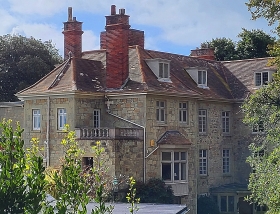
According to a booklet I purchased in the Old Church, between July and October 1849, Dickens stayed in a large house called Winterbourne (see photograph), which he had rented from his friend the writer and vicar, Reverend James White. It was here that Dickens wrote six chapters of his novel “David Copperfield”. Each of these chapters were initially published month by month, as was the case for many of the author’s other stories. In addition to writing, Dickens enjoyed rambling in and around Bonchurch and playing rounders on the seashore. Also, he spent much time socialising with James White and his wife Rosa, who lived elsewhere in the village. A website (www.bonchurchvillage.co.uk/post/a-christmas-story-the-grandfather-s-story) recorded:

“Dickens and his wife Catherine with their children became very close friends of Rev. White and Rosa White (nee Hill) and their children during their holiday at Winterbourne in 1849.”

It also noted:

“James White had already had success with plays performed in London and stories contributed to ‘Blackwells Magazine’ in Edinburgh.”

A visit to Bonchurch is a delightful experience. Climbing its steep roads and paths makes a picturesque substitute for a ‘work out’ in a gym.

Coffee al fresco

THE COVID19 PANDEMIC has, for the time being, made drinking inside cafés a thing of the past. If you wish to enjoy a beverage, be it a cappuccino, cortado, americano, a hot chocolate, or even a humble cup of tea, you can buy it at a counter and then enjoy it outdoors, come rain, snow, or shine. In the absence of restaurants and pubs, with the exception of take-away foods, this has become one of the few little treats, apart from the joys of nature, available to those who wish to enjoy a bit of life out in the open air.

Not long ago, whilst exercising in London’s Hampstead district, we came across a particularly lovely place to obtain hot drinks and a selection of snacks, both sweet and savoury. They are being served under a canopy illuminated by strings of ‘fairy lights’ on a terrace overlooking the sloping garden of Burgh House.

Built in 1704 during the reign of Queen Anne, Burgh House was, according to the historian of Hampstead, Thomas Barratt, first owned by a Quaker couple, Henry and Hannah Sewell. Barratt remarked:

“…the house gives the idea of Quaker severity of style combined with a good quality of work.”

The house acquired its present name in 1822, when it was the residence of the Reverend Allatson Burgh (1769-1856), who was for a time vicar of St Lawrence Jewry (http://www.burghhouse.org.uk/about-us/history-of-the-residents-of-burgh-house#revburgh). He was also the author of a book about church music. Prior to the cleric, the house was occupied, between 1776 and 1820, by the upholsterer Israel Lewis (1748-1820) and his wife Sarah, both known for their good deeds. Lewis was a supporter of the non-Conformist Rosslyn Hill Chapel in Hampstead. The family also provided assistance to the poet John Keats (1795-1821) and his brothers. On the 16th of October 1818, the poet wrote to his brother, who was living in the USA, George Keats (1797-1841):

“Mr Lewis has been very kind to Tom all the summer. There has scarce a day passed but he has visited him, and not one day without bringing him or sending some fruit of the nicest kind.”  (“The Letters of John Keats: Volume 1, 1814-1818”)

Burgh House is close to the former chalybeate wells of Hampstead, which were famed for their alleged curative properties. Before the Lewis’s lived there, it was the home of the chief physician of the Wells and a promoter of the benefits of its water, Dr William Gibbons (1649-1728) and his wife Elizabeth. They lived in the house between 1720 and 1743, Elizabeth continuing to live there as a widow.

After Burgh’s death in 1856, the house named after him became the officers’ mess and headquarters of the Royal East Middlesex Militia between 1858 and 1881. The house was then privately owned by several other people, the last of whom were Captain George Louis St Clair Bambridge (1892-1943) and his wife Elsie (1896-1976). Mrs Bambridge’s father was the writer Rudyard Kipling, who was born in Bombay (India). The Bambridges lived at Burgh House between 1933 and 1937. During that time, the ageing Rudyard was a regular visitor.

After the Bambridges left Burgh House for Wimpole Hall in Cambridgeshire, the venerable building faced dilapidation until it was taken over by Hampstead Borough Council in 1946. It was then used for social functions such as wedding receptions.

After a long campaign and much fund-raising, the house was opened to the public as a museum in 2006. In addition to displaying items of historical interest, concerts, talks, and other cultural events are also held there. The concerts are held in a music room that the Reverend Burgh added on to the building when he occupied it.  All these life-enhancing activities have come to a halt during the covid19 pandemic. The pleasant and attractive outdoor café is helping to keep the community spirit alive until rates of infection decrease sufficiently to allow at least some return of the cultural activities that we used to enjoy.

The Burgh House café is open from Wednesday to Sunday. Should you visit Hampstead when the café at this place is closed, there are another three Hampstead places, from which we enjoy collecting hot beverages:

Ginger and White in Perrins Court

The Coffee Cup in Hampstead High Street

Matchbox Café in South End Green

There are also a couple of telephone kiosks that have been converted to tiny cafés both in Hampstead High Street and Pond Square, but we have never sampled their wares.