
I HAVE WRITTEN about this place before, but because it is so lovely, I will write about it again. Located in Leicester Place, which runs north from Leicester Square, it is the francophone Roman Catholic church of Notre Dame de France. Constructed earlier than the mid-19th century, it was originally a visitor attraction known as Burford’s Panorama. In 1865, the French Church bought the building and with the help of the architect Louis-Auguste Boileau (1812-1896), it was converted into a church. He retained the circular plan of the former Panorama and kept its dome. It was the first church in London to incorporate cast-iron structural elements. Badly damaged during WW2, it was rebuilt between 1953 and 1955 under the supervision of the Greek born architect Hector Corfiato (1892-1963).

By Timur D’Vatz
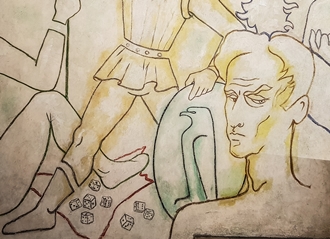
The church is a peaceful haven in a busy district of London. During the day, there are usually several homeless people lying asleep on the pews. Until our recent visit in August 2024, we usually made a beeline for a side chapel on the north side of the church. The walls of this small chapel are covered with coloured line drawings by Jean Cocteau (1889-1963). Depicting the Annunciation, Crucifixion and Assumption, Cocteau completed them in a week during 1962. In addition to the walls, Cocteau painted a wooden panel to cover the front of the chapels altar. This has been removed because it covered a mosaic created in 1954 by the Russian born artist Boris Anrep (1883-1969), who is best known for his mosaics on the floor of the National Gallery. The wooden panel can now be viewed in an alcove next to the chapel. After we had paid homage to the Cocteau drawings, we decided to look at some of the other artwork in the church.
There is a large tapestry above the high altar. It is based on the theme ‘Paradise on earth’, and was created in 19 by Dom Robert de Chaumac (1907-1977), a Benedictine monk from France. He was a friend of Jean Cocteau. Between 1948 and 1958, Dom Robert lived at Buckfast Abbey in Devon. The tapestry was woven in France in 1954. High up on the southeast wall of the church there is an attractive painting depicting the Flight of the Holy Family into Egypt. It was painted in 2016 by Timur D’Vatz, who was born in Moscow (Russia) in 1968. Between 1983 and 1987, he studied art at the Republican College of Art, Tashkent, and between 1993 and 1996, he studied at London’s Royal College of Art. He arrived in London from Moscow in 1992. In 2004, he acquired a studio in France.
Two polygonal incised stone ambos (lecterns) can be seen, one on each side of the high altar. The one on the north side has carvings and names of New Testament figures, and that on the south has Old Testament names and figures. I have not yet found out who designed or made these elegant geometric items. Likewise, I do not know who created the illustrated tiles that can be found at each of the Stations of the Cross.
The façade of the church is worth examining. High above the entrance to the church, there is a large carved stone bas-relief depicting Our Lady of Mercy. It was created in 1953 by the French sculptor Georges Saupique (1889-1961). Below this and flanking the entrance, there are two attractively carved pillars with eight scenes from the life of Mary. These were carved by students from the École des Beaux-Arts in Paris (France).
 yamey
yamey 