
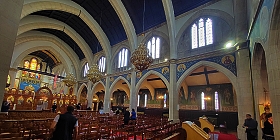
ST CLEMENT’S CHURCH in central Cambridge began being constructed in the 13th century. It was modified in later centuries. While many Anglican churches contain one or two Orthodox-style icons, St Clement’s has many of these, including a large one depicting the Mother and Child, flanked by typical Orthodox style, sand-filled candle holders. In addition, there are several large reproductions of frescos of portraits of Orthodox saints including St Clement. Apart from the Orthodox Church features within the building, there are furnishings that one would expect to find in any Anglican church.

The reason that the Orthodox ‘fittings’ fill the church is that St Clemnt’s doubles up as a church for an Anglican congregation and also for a local Russian Orthodox congregation, the members of the Parish of St Ephraim the Syrian, which is an English-speaking Russian Orthodox parish of the Diocese of Sourozh. In the Orthodox church, a screen called the ‘iconostasis’ and usually covered with religious paintings separated the clergy from the congregation. St Clement’s contains an iconostasis, which is retractable. During Orthodox masses, the hinged screen can be unfolded to hide the chancel from the rest of the church. When the Orthodox congregation are not using the church, it is folded away, and can hardly be seen from the nave. I had never seen a retractable iconostasis until I first entered St Clement’s (in August 2025).
One other noteworthy feature in the church is a mural on the east wall above the (Anglican) high altar. It was painted in 1872 by Frederick Richard Leach (1837–1904), who was born in Cambridge and later worked with the designer and social activist William Morris (1834-1896).
I have visited Cambridge numerous times and often passed St Clement’s, but it was only in August 2025 that I first stepped inside. I am glad I did because although it is a fine mediaeval church, its use by two Christian denominations and, in particular, its folding iconostasis makes it especially interesting.
 yamey
yamey 