
RARE SURVIVALS IN A MEDIAEVAL PARISH CHURCH IN SUFFOLK

DURING THE REIGN of King Henry VIII, many English churches were vandalised because of the monarch’s divorcing the country from the Roman Catholic Church. Many artefacts were destroyed in churches to erase their connection with the Church in Rome. These included carvings and stained-glass windows. Holy Trinity Church in the wool town of Long Melford in Suffolk was no exception. Above the south entrance to the church, you can see empty stone frames that once contained stone effigies of saints. Much of the 15th century church’s mediaeval stained-glass was also destroyed.

Luckily for us, some of the stained-glass survived. This is because it used to be located in the windows of the clerestory high above the long nave – out of reach of the people sent to destroy it. In recent times, the surviving windows have been restored and placed in the windows lining the north wall of the church. These windows are much lower than those in the clerestory, and are easily viewed from the ground. The windows depict both dignitaries and religious subjects, which were the main targets of the vandals who were destroying religious images.
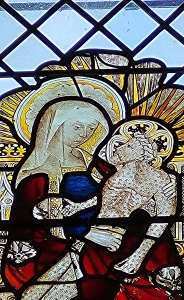
One of the windows is particularly interesting because it shows the Virgin Mary holding the dead body of Christ soon after it had been removed from the Cross. In other words, it is what is known as a Pietà. This subject matter was, and still is, extremely important in Roman Catholic imagery, and had they been able to reach it, those who attacked the church would have certainly wanted to destroy this.  A knowledgeable gentleman, who was helping in the church, told us that the pre-Reformation Pietà in the church was an extremely rare survival from the time before Henry decided to break with Rome. What is more is that unlike many images of the Pietà, the dead Christ is shown with his eyes wide open.

The Pietà image in the surviving mediaeval stained-glass is just one of many interesting things that can be seen in the magnificent, large parish church at Long Melford. As the Michelin Guidebooks often say, the place is “worth a detour”.

Two colourful churches

THE SUNDAY MORNING SERVICE at the parish church, St Mary the Virgin, in Haverhill in Suffolk had just ended when we entered the building. My wife chatted with a priest, who said he knew little about this church’s history. She asked him if there were any other churches in the district worth a visit. He mentioned two across the county border in Cambridgeshire, at the villages of Bartlow and at Hildersham. The two churches have something of interest in common: unusual colourful paintings.

Bartlow’s St Mary’s church has a distinctive round bell tower. But this is not the only thing that is remarkable about it. It was built in the 11th or 12th century and modified gradually during the following centuries. A real treat greets the visitor on entering the building: some colourful 15th century wall paintings, two on the south wall and one on the north. They depict St George’s dragon (north wall), and opposite this on the south wall: St Michael weighing the souls on The Day of Judgement, and east of it another shows a portrait of St Christopher carrying the Christ Child. The paintings existed long before the Civil War. On the 20th of March 1644, they were covered up with paint by Oliver Cromwell’s men under the command of William Dowsing (1596-1668), a fanatic iconoclast, also known as ‘Smasher Dowsing’. The frescos began to become uncovered in the 19th century, but it was only in 2014 that serious conservation work was undertaken on them.

St Christopher painting at Bartlow

The artists who created the wall paintings at Bartlow have been long forgotten, but this is not the case for the creators of the colourful chancel at Holy Trinity Church in nearby Hildersham. In 1806, the Reverend Charles Goodwin was appointed Rector of Hildersham. Ten years later, his son Robert was born. He studied at Clare College in Cambridge and whilst a student he joined The Cambridge Camden Society, whose aims were to promote the study of Gothic architecture and ‘ecclesiastical antiques’. This society grew to be a great influence on the design of Victorian churches.

In 1847, following the death of his father, Robert became Rector of Hildersham’s church. Soon, he began to consider how to ‘restore’ his church in accordance with gothic revival ideals. Amongst these ‘improvements’ was the painting of frescos on the walls of the chancel. These were executed using a novel technique known as ‘spirit fresco’, which made use of a complex mixture of beeswax, oil of spike lavender, spirits of turpentine, elemi resin, and copal varnish. This technique, invented by Thomas Gambier Parry (1816-1888), produced durable images that were easier to produce than the traditional fresco technique used, for example, in renaissance Italy. The chancel at Hildersham was painted using the new technique by Alfred Bell, John Clayton, and Stacy Marks. They and many assistants produced a magnificent display of saints and religious scenes, all from The New Testament. They were painted in 1890 and are in wonderful condition. The two churches are just under 4 miles apart and both are well worth visiting. And, when you do go to these buildings, you will find light switches near their entrance doors. We might never have seen them had it not been for my wife engaging in friendly conversation with the priest at Haverhill.