
Green hops and beer at a pub near Tonbridge in Kent

THROUGHOUT THE COUNTY of Kent, you will spot the conical roofs of oast houses in which the hops used to flavour beer are dried. Many of these curious looking buildings are no longer used for their original purpose. Many of them have been converted into picturesque residences. In late October 2025, we booked a table to eat lunch at the Dovecote Inn, a pub near Capel, which is not far from Tonbridge in Kent. We were advised that it might be noisy because there would be a beer festival going on when we were there.
The event was “The Dovecote Green Hop Festival”. Green hops, sometimes called ‘wet hops’, are hops harvested from the vines (the ‘bines’), and used to make beer within 24 hours of having been picked. The beers produced with these fresh, rather than dried, hops, have their own distinctive flavours, which are fresher and more vibrant than other beers. This is because the green hops contain ingredients that are lost when hops are dried out. However, to produce beer with the freshly picked hops, a far greater quantity of hops is required than when using the dried ones. I tried one of the green hop bitters, and it tasted wonderful.

The Dovecote Inn turned out to be a delightful, small late eighteenth century establishment. Its landlord was extremely friendly, as were his team of staff. Although we had to wait a long time for our food, it was well-worth waiting for. As for the noisy festival about which we had been warned, it did not seemed to have taken off by the time we ate there early on a Friday afternoon. We looked around at the customers and amongst about twenty people, only four of them were drinking beer. I suspect that had we stayed until the evening, the beer consumption level would have increased by then.

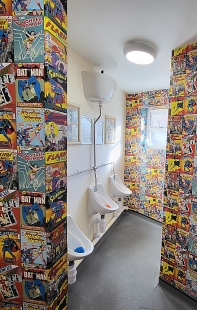
On the way out, I paid a visit to the men’s toilet. This was a sight to be seen. The walls of this part of the pub are covered with an eye-catching wallpaper whose design is a dazzling collage of American comic covers (“Bat Man”, “Wonderwoman”, Superman”, etc.).

Only a few miles from Tonbridge, The Dovecote Inn is well worth a visit, but if you plan on eating there, leave plenty of time.
They are only there for the beer

DESPITE LIVING IN KENT for eleven years and having visited the county numerous times, it was only in October 2021 that I first stepped inside an oast house. Dotted all over the county with their tall conical (sometimes pyramidical) roofs surmounted by distinctive cowls, they play(ed) an important role in the production of beers.

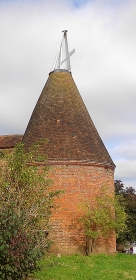
An oast house with conical roof

Hops are the flowers (or seed cones) of the hop plant known by botanists as Humulus lupulus, a member of the Cannabaceae family of plants, whose members include Cannabis, the plant which is the source of marijuana. Only the flowers of the female hop plant are used in beer making. When dried to a well-defined degree, hops are added to the beer-making process both to add flavour and because of their antibacterial effects that prevent unwanted organisms growing whilst the beer is being brewed.

Traditionally in England, hops are dried out in oast houses. Picked hops are laid out on perforated drying floors in the upper levels of the oast house. A wood or charcoal fired kiln on the ground floor of the oast house produces hot air that drifts upwards through the layers of drying hops and then escapes through the cowl at the top of the oast house’s conical roof. The cowl has a vane that catches the wind and rotates the cowl so that the wind continuously draws the smoke from the kiln up through the oast house. The air that carries the smoke upwards is drawn into the oast house through perforations in the brickwork at the lower levels of the building. The tall conical design of the roof increases the draught of air through the hops. The drying process must be carefully monitored so that the hops are removed before they are dried out too much.

The earliest known record of hop cultivation was in a document dated 736 AD. It referred to hops being grown in Germany. The use of hops in beer production seems to have taken off in a big way by the 13th century. Before hops became used routinely in beer production, a mixture of herbs and flowers, known as ‘gruit’, was used for the same reason as hops. In Germany, hops became favoured over gruit in the early 16th century because unlike the latter, which were subject to taxation, the former were not (https://en.wikipedia.org/wiki/Hops).

Hops were introduced to England during the 16th century. The oldest description of an oast house (more accurately, a building for drying hops) was written in 1574. What was described was different in design to what we recognise as an oast house today. The earliest surviving oast house was built sometime during the following century. Today, hops are no longer dried in oast houses. They are processed in industrial premises that are not nearly as picturesque as oast houses, many of which have now been repurposed as dwellings and for other uses.

On the estate of Sissinghurst Castle, a former manor house rather than a castle, a set of former oast houses has been tastefully modified by the National Trust to create an exhibition space that includes information about oast houses and hop drying. Although the kilns are no longer present, the internal structures of the tall roofs have been preserved. By entering the exhibition space, I managed to see inside an oast house for the first time. I would be curious to see within an oast house that still contains its kiln and other equipment, but what I saw at Sissinghurst began to quench my thirst for knowledge about these curious looking buildings, which were only there for the beer and can be seen throughout the landscape of Kent.