
I LIKE THE WORD “environs”. I believe that I first encountered it as the title of an American road map of Philadelphia, which I acquired when I was living in Chicago, Illinois, in 1963. In those days, I was an avid collector of maps, and I had a relative who lived in Chicago and worked for the Sinclair Oil Corporation. It was he who gifted me a collection of Sinclair’s company road maps and some others, which included the one mentioned already.
The word ‘environs’ is according to an etymological website (www.etymonline.com):
“… late 14c. (implied in environing), “to surround, encircle, encompass,” from Old French environer “to surround, enclose, encircle,” from environ “round about,” from en- “in” (see en- (1)) + viron “a circle, circuit,” also used as an adverb, from virer “to turn” …”
So, it was an appropriate word to use in my book “BENEATH A WIDE SKY: HAMPSTEAD AND ITS ENVIRONS”, which I published in 2022. The ‘Wide Sky’ refers to the firmament above Hampstead, which fascinated, and was often painted by, the artist John Constable. The ‘environs’ include several places around Hampstead, which are described in the book, and listed below.
My book includes West Hampstead and North End, which although some distance away from the heart of Hampstead, have always been considered part of Hampstead. Its many residents have included a former British Prime Minister -William Pitt, the Elder – and a famous architectural historian – Nikolaus Pevsner. Golders Hill Park, once the grounds of a stately home, lies partly in the borough of Camden, and partly in Barnet. So, much of it is an environ of Hampstead.
Hampstead used to be separated by countryside from Swiss Cottage. I have written about this place, which is where I went to school between 1960 and 1965. Close to my old school, there is a drama school and a separate, highly acclaimed theatre. Although not as old as Hampstead, Swiss Cottage is not devoid of interest. For example, Sigmund Freud lived the last years of his life in the area. And near his former home, there is the Tavistock Institute, which has attracted some controversy in recent years. And the architecturally interesting Swiss Cottage Library, built in the early 1960s, is well worth a visit.
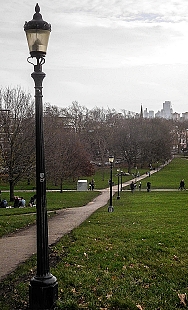
Primrose Hill (see photo above) also deserved a chapter in my book. It was visited by the artist/poet William Blake. The windows of the house where the philosopher Friedrich Engels for several years lived looked over towards the Hill. It was here that Karl Marx visited his friend Engels often. Nearby, later, the poet Sylvia Plath also resided for a while.
I have written quite a long chapter about Highgate, which is where I went to school between 1965 and 1970. Like Hampstead, the old village is rich in historic buildings and has had many now famous residents. This chapter also includes amongst many other places of note Highgate Cemetery, Kenwood, and its close neighbour the Spaniards Inn. Lesser-known places including a former school for Jewish boys and a block of flats designed by the Modernist Lubetkin are also described in this section of my book.
As you are probably beginning to realise, my book about Hampstead, which focusses mainly on the place, does include a great deal about areas that surround the old village. Apart from being factual, my book includes personal reminiscences of all the places described in it. What you will find when you read it is that you are in the hands of a guide who has known the area well for over six decades.
To obtain a copy of the book (or its Kindle version), head for an Amazon website such as:
https://www.amazon.co.uk/BENEATH-WIDE-SKY-HAMPSTEAD-ENVIRONS/dp/B09R2WRK92/
 yamey
yamey 