
By car from Kuwait to London

ON THE FIRST OF August (2023), we went to one of our favourite kebab shops – Raavi in London’s short Drummond Street (near Euston station). There was a large Datsun saloon car parked outside Raavi, and another across the road. Neither of them was in pristine condition.  Both were covered with stickers, and each had Kuwaiti registration plates. On the front bonnet of each of them were the words:

“Kuwait to Paris to London 2023”
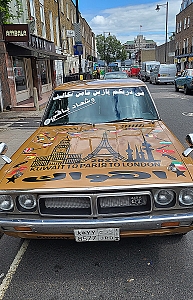
Beneath these were words in Arabic. Above the word ‘Kuwait’, there was an image of London’s Big Ben. Above ‘Paris’, there was an image of the Eiffel Tower, and above ‘London’, there was a picture depicting some Kuwaiti landmarks. In Arabic, one reads from right to left. Therefore, reading the Arabic way, the images depict: Kuwait to Paris to London’.

On each of the car’s bonnets, there were flags of different countries and either a boat or an arrow between neighbouring flags. Reading the bonnets from right to left, the route taken by the intrepid drivers of these cars was as follows:

By sea from Kuwait to Turkey; by road from Turkey to Bulgaria to Romania to Hungary to Slovakia to Poland to Holland to Czech Republic to Austria to Belgium to Germany to Italy to France to England to Spain. Then, by ship to Morocco.

The order of the countries seems a little odd. Maybe, a few have been omitted. Because there is an arrow rather than a ship between France and England, and between England and Spain, I guess that the cars travelled through the Channel Tunnel.

I do not know why these cars were parked in Drummond Street, but whoever drove them had made a journey that I am sure I would have enjoyed.

Macchiavelli and spicy masala meat dishes

RAAVI KEBAB BEGAN serving Pakistani and Punjabi food in the mid-1970s. It is located on Drummond Street, close to London’s Euston Station. This unpretentious eatery with barely any internal decoration except some mirrors with Koranic verses engraved on them in Urdu script, is next door to the Diwana Bhel Poori House. It was at the latter that we used to enjoy Indian vegetarian dishes when we were undergraduate students at nearby University College London during the first years of the 1970s. In those days, Raavi, named after the river that flows through the now Pakistani city of Lahore, did not yet exist. It was only in the early 1990s that a friend visiting from Bombay suggested that we ate with him at Raavi’s. When the grilled kebabs arrived at our table, it was love at first bite. We have been returning to Raavi’s ever since.

Raavi’s with Diwana in the backround

Yesterday (1st of September 2022), we made yet another visit to Raavi’s. As we sat down, I noticed a thick wad of photocopies held together with a bulldog clip. They were resting on top of a neatly folded shawl. Out of curiosity, I looked at the top sheet, which was a page copied from a book with annotations added in red ink. I looked more carefully and noticed that the printed text was in Italian. The page was headed “<De ingratitudine> Joanni Folci Niccolaus Maclavellus”. It is a chapter (‘The ingratitude of Joanni Folci’) from a book by Niccolò Machiavelli (aka Maclavellus), who lived from 1469 to 1527. The rest of the text on the photocopied page appeared to be a learned commentary on Macchiavelli’s chapter.

I do not know why, but I felt that Raavi’s was the last place I would expect to find scholarly papers lying about so casually. I associate the place, as do most of its many customers, with grilled meat and spicy masalas. I asked the waiter about the papers. He shrugged his shoulders and said that someone must have left them behind after eating, and that he had no idea whether anyone would return to retrieve them.