IT IS EASY to understand the great popularity of paintings by David Hockney. They are colourful, often cheerful, and full of life. Until 23 August 2026, there is a delightful exhibition of his work at the Serpentine North gallery in London’s Hyde Park.
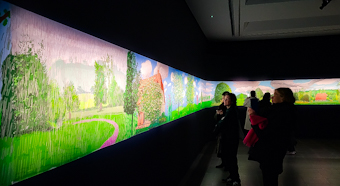
The highlight of the show is a series of prints of images that Hockney created on his iPad in France. They are joined together to form a huge, long picture depicting the seasons in the countryside of Normandy in France. Entitled “A Year in Normandie”, it was inspired by the famous Bayeux Tapestry. However, unlike the tapestry that portrays military activities, Hockney’s twenty-first century take on it contains only idyllic views of a peaceful countryside, changing in appearance as the year proceeds. The result is wonderful.
In addition to the Normandy scenes, there is a good selection of Hockney’s portraits on canvas. Painted mainly during the last year or two, many of them include objects such as tables painted so that perspective has been reversed. For example, the front of a table in a picture is painted narrower than the distant end of it.
All in all, this is a great exhibition. It shows that advancing age need not be an impediment to creative artistic productivity: Hockney is in his late eighties, soon to be 90.
THE ARTIST DAVID Hockney (born 1937) had his eighty-eighth birthday in July 2025.Yet age has not stopped him from creating prolifically. Today, 25 February 2026, we visited an exhibition of his work at the Anely Juda Fine Art Gallery in London’s Hanover Square. It is on until 28 February 2026.
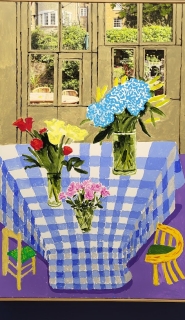
The upper gallery on the first floor is a collection of works, moonscapes and nightscapes, that Hockney created on an iPad, and then had printed and framed. I am no lover of Hockney’s iPad creations, and those on display did not excite me. However, in the ground floor galleries, a treat awaited us. On display was a collection of oil paintings, all created by Hockney in 2025. They include several portraits, depictions of interiors with and without people, and a self-portrait in which the artist can be seen painting while seated in a wheelchair. In some of the pictures, instead of painting the view through a door or window, the artist has pasted photographs of what can be seen outside onto the canvas. Each of the paintings displays a joyful love of life and is richly coloured. In addition, Hockney experiments with perspective in some of the paintings, often with pleasantly surprising results.
To summarise, this is an exhibition worth seeing if you happen to be in London during the next few days. Like Picasso, Hockney demonstrates that advancing age need not necessarily curtail artistic expression.
THE CARTWRIGHT HALL Art Gallery in Bradford has a collection of paintings by David Hockney (born 1937), some of which he did when he was as young as 16. These early paintings, though not as adventurous as his later work, show that even as a teenager, he was a skilled artist. He studied art at Bradford College of Art. Then, between 1959 and 1962, he continued his studies at London’s Royal College of Art (‘RCA’). It was after his arrival in London that Hockney began experimenting with new ways of expression in painting. Apparently, he was not an ideal student in the eyes of the RCA. For example, he did not attend lectures and did not do the prescribed coursework. Yet, he created numerous paintings that are evidence of his skilful breaking away from conventional painting. Today, we caught the last day of an exhibition of the paintings he did between 1959 and 1963. It was held at Hazlitt Holland-Hibbert Gallery in Mayfair’s Bury Street.
Detail from the Diploma etching
The gallery’s website explained:
“Exhibited together for the first time, these early paintings embellished with love hearts, graphic text, suggestive shapes and depictions of friends and lovers reveal David Hockney’s precocious talent during the most formative chapter of his career.
In 1959, Hockney moved from Bradford to begin his studies at the Royal College of Art, London, where he was determined to experience the capital’s postwar bohemian culture as well as absorb the modern and contemporary art in its museums and galleries. The exhibition focuses on this period before Hockney relocated to the United States at the end of 1963 and reveals his discovery of an unmistakably personal style of painting that would establish him as the most important artist of his generation.”
It was exciting to view the images he created during this important period of his artistic development. However, for a while the RCA failed to appreciate him, and for a while threatened not to award him his degree. An article in Wikipedia revealed:
“When the RCA said it would not let him graduate if he did not complete an assignment of a life drawing of a live model in 1962, Hockney painted ‘Life Painting for a Diploma’ in protest. He had refused to write an essay required for the final examination and said that he should be assessed solely on his artworks. Recognising his talent and growing reputation, the RCA changed its regulations and awarded him a diploma.”
An etching in the exhibition, “The Diploma”, created in 1962, reflects Hockney’s protestation. Since graduating from the RCA, Hockney has been given awards by many prestigious institutions, and was made a Royal Academician.
Having seen his earliest known works in Bradford, the works done while at the RCA, and later creations, it is easy to understand why Hockney is now regarded as an artist of the highest calibre.
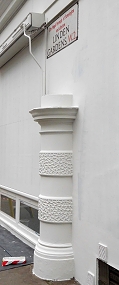
AT THE EASTERN END of Notting Hill Gate, there is a road called Linden Gardens. In the 1860s, only the eastern part of this existed and it was named Linden Grove. To the west of Linden Grove was Linden Lodge, set in extensive grounds with a large pond or lake. It was designed by the engraver, architect, and property developer Thomas Allason (1790-1852) and constructed in 1826. He lived there until about 1838. In the late 1860s, the Lodge was demolished, and houses were built around the edge of, and on, its grounds. This occurred because of the construction of the Metropolitan Railway in the mid-1860s. The gateposts of the lodge still stand, partially embedded in the buildings at the south end of Linden Gardens.
The website british-history.ac.uk noted that it was probably the peacefulness of the Grove:
“… which attracted two other artists, William Mulready, who lived in the southernmost of the eight paired houses (now demolished) from 1828 until his death in 1863, and Thomas Creswick, who lived at the still surviving No. 42 from 1838 until 1866. In the latter year this house was affected by the building of the Metropolitan Railway. Creswick therefore moved to Mulready’s now vacant house, and also, apparently, occupied the adjoining house to the north (with which it formed a pair) until his death in 1869.”
William Mulready (1786-1863) was the designer of the penny postage envelope depicting Britannia. Creswick (1811-1869) was a landscape painter and illustrator. Someone, who lived in Linden Gardens, told me that some of Queen Victoria’s children received art lessons in a studio in Linden Grove, but I have found no evidence to confirm this. However, it is certain that David Hockney painted Mr and Mrs Clark and Percy, a portrait of the dress-designer Ossie Clark (1942-1996) and his wife in their flat in Linden Gardens. The balustrades in the painting are typical of those on most of the first-floor balconies of the houses in the Gardens.
Another artist, Elsa Fraenkel (1892-1975), a German-Jewish born sculptor and Fellow of The Royal Society of Arts, who fled from the Nazis, also lived briefly in Linden Gardens, so I was informed by her daughter, who lives in Bangalore (India), where Elsa died.


 yamey
yamey 