Once it celebrated Muhammad Ali Jinnah now it honours Subhash Chandra Bose

Subhash Marg, a busy bazaar street in Bikaner (Rajasthan, India), It leads northwest from the 16th century Kote Gate in the heart of the city and runs alongside a railway track.

In the past, this road had been named Jinnah Road in honour of the founder of Pakistan. Still known as Jinnah Road by many of its Muslim inhabitants, in 1967 it was given its new name (Subhash Marg). According to an article published in the Hindustan Times in 2016, neither Muhammed Ali Jinnah nor Subhash Chandra Bose ever visited Bikaner.

We ate an uninspired non-veg lunch at the Muslim run Simran Restaurant on the road. On the bill, its address was given as “Subhash Marg (Jinnah-Road)”, and that was 57 years after the street’s name was changed.

Street name changes are not uncommon in India, but usually the old names of a thoroughfare are remembered better than the often-forgotten new names

The hands of women about to be consumed by fire

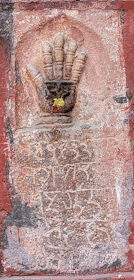
ON THE WALL NEXT to one of the several gates, the Daulat Prole, that leads into the Junagarh Fort in Bikaner, you can see a set of what look like the impressions made by pressing hands into a soft material. Each of these hand prints is labelled in Hindi (Devanagari) lettering. These impressions are amongst the last actions of widows about to commit sati.

Sati was the usually forced self-immolation of widows. Sati was the tradition in India that involved widows being forced to throw themselves on their husband’s burning funeral pyre. Sometimes, they did it apparently voluntarily. It was a tradition often practised by Rajputs, but not restricted to them. During the British occupation of India, there were various attempts to outlaw sati, but incidences of it continued into the 20th century. Finally, in 1987, the Government of India passed an Act criminalising the practice of sati and its glorification.

Returning to the hands at the Junagarh Fort, one of the officials guides told us the following. Prior to being caste onto her spouse’s funeral pyre, the noble Rajput widow would dress in her finest clothes and jewellery, and approach the Daulat gate. By this time, her hands would have been covered with henna (mehndi). She would then press the palm and digits of her right hand on a stone slab, leaving a print of her hand on it. Later, an artisan carefully carved a three-dimensional impression of the widow’s hand. By that time, the poor woman had been incinerated.

In Rajasthan, various of the Princely States abolished sati in the first half of the 19th century. In Bikaner, the last Maharani to die on her husband’s pyre was in about 1825, so we were told by the guide at the fort.

My eye was immediately attracted to the sati memorials. I wonder how many other visitors to the Junagarh Fort stop and contemplate these tragic memorials before proceeding with taking photographs of each other at the many picturesque spots within the fort.

Going Dutch in the fort at Bikaner

UNLIKE JAIPUR, JODHPUR, and Jaisalmer, the city of Bikaner in Rajasthan is not (yet) overrun with tourists. We have been in Bikaner for three days and apart from at the Junagarh Fort (Bikaner’s most significant historical attraction), we have seen only one European visitor. Bikaner differs from the three Rajasthani cities mentioned in the first sentence in that its streets are not lined with shops designed to attract tourists. Apart from the fort the rest of the city is a fascinating, busy working environment, which someone, like me, who enjoys observing everyday scenes of life in India, has plenty to see.

Many of the older buildings that can be seen in the streets of Bikaner have jharokas – decorative, stone-framed windows that project over the street. They are commonly seen features of the Rajput style of architecture and are still being constructed.

The Junagarh Fort is rich in jharokas. Many of them overlook courtyards within it. One of them is of great interest. From a distance it looked to me like it was decorated with blue and white tiling, like Portuguese azulejo work. Close up, it can be seen to be something else.

A huge consignment of Dutch blue and white Delft ceramic plates had been ordered for the royal family of Bikaner. When that was, I do not know. While they were being transported to India by sea, they were damaged, and arrived broken. Instead of throwing them away, the thrifty maharajah had them cut up to produce tiles, all of which bore details from the pictures that had decorated the plates. The tiles were then used to decorate both the inside and the outside of the jharoka overlooking a courtyard that contains an elaborate water feature: a pool with fountains.

Although there is much more to be seen in the fort, this example of repurposing broken plates intrigued me. The Junagarh Fort is definitely a must-see attraction in Bikaner, but it it is now merely a museum-like remnant of the past. Visitors to the city should see this, but also set aside at least a few hours to absorb the busy atmosphere of enterprise, both traditional and contemporary, in the older districts of Bikaner.

A Maharaja at Versailles and his silver soup spoon

THE OLD FORT of Bikaner dominates the centre of the bustling city of Bikaner in Rajasthan. Visitors can view rooms and halls within the fort by joining a guided tour. The tour we joined was led by an intelligent, informative man. The architecture of the fort and much of its interior decorations are spectacular. Amongst the many exhibits we saw were some relating to Maharaja Ganga Singh (1880-1943), who was ruler of Bikaner from 1888 until his death.

The Maharaja’s full title was General Maharaja Sir Ganga Singh, which reflects his role during two world wars. During WW1, he commanded the Bikaner Camel Corps, which served in France, Egypt, and Palestine. Before that, he served in China during the suppression of the Boxer Rebellion. During WW1, he was appointed a member of the Imperial War Cabinet. Because of this, he was present at the signing of the Treaty of Versailles in 1919. He was the only Indian signatory, the only non-European, at this momentous occasion. Later, he represented India at the League of Nations. In addition to his military achievements, Ganga Singh did much to improve the living conditions and economy of his state.

The Maharaja’s soup spoon

Within the fort there are many memorabilia connected with Ganga Singh. The most intriguing of these is a silver spoon designed so that the Maharaja could eat soup without it touching his impressive moustache. The bowl of the spoon has a barrier that would have kept the moustache pushed away from the soup in its bowl.

Among many other souvenirs of Ganga Singh is a De Haviland DH-9E aeroplane. This was one that had been shot down during WW1, and given to Ganga Singh in recognition of Bikaner State’s services during the war. It was restored by Maharaja Karni Singh in about 1985, and is now housed in one of the fort’s huge assembly halls.

I have described two of the things that amazed me during my visit to the fort. I plan to describe more soon.