
ONE OF ISTANBUL’S many attractions is that it is intimately associated with water: the Golden Horn, the Bosphorus, the Black Sea, and the Sea of Marmara. Incorporated within the city’s excellent public transport system, there are many boat services on all these bodies of water. During our recent visit to the city in April 2024, we took a boat from Kabataş on the European shore of the Bosphorus to Büyükada – one of the Princes Islands out in the Sea of Marmara. This pleasant journey took about 1 hour and 40 minutes. As we sailed across the smooth sea, flocks of seagulls followed us, and were fed by other passengers, who threw them bread and other titbits.
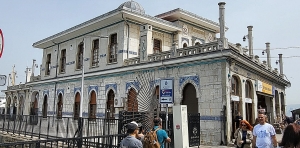
One of the piers at Büyükada has a beautiful old quay building in which passengers can wait for their boat and do a little shopping. Equipped with ticket windows, which are no longer in use because modern ticket machines have replaced them, the building is decorated with lovely tiling and stained-glass windows. As with many old buildings we saw in Istanbul, this one was supplied with a panel describing (in both Turkish and English) its history.
The pier was built in 1899. It was rebuilt with the addition of the present two-storey terminal building, which was completed in 1915 to the designs of its architect, Mihran Azaryan (1876-1952) from Izmit. He was an Ottoman Armenian. It is worthy of note that by the time that his building was built, the Ottoman rulers had been involved in the death of many Armenians.
The upper floor had a café between 1918 and 1923. And between 1950 and 1951, it had been the island’s first ever cinema. Between 2000 and 2001, the edifice was beautifully restored, and although the ticket windows no longer serve any purpose, its octagonal waiting room-cum-ticket hall is a rare survival.
Having seen this superb example of a ferry terminal, I kept my eyes open during the many other boat trips we made along, and across, the Bosphorus. Many of the landing stages have ornate terminal buildings – often with tiling and stained-glass windows, and sometimes with their names still in the old Turkish script. However, the terminal at Büyükada is the most impressive of all those we saw.
 yamey
yamey 