ON OUR WAY to visiting friends, who live in Tonbridge (Kent), we stopped to look at the Church of St Thomas à Becket in the village of Capel. The saint lived from c1120 until his murder in 1170. An old tree in the churchyard at Capel is fenced off and alongside it, there is a label that informs the reader that the saint was:
“… supposed to have preached beneath this lovely old yew tree.”
Given that it is now the year 2025, the very latest that he could have preached beneath this tree would have been 855 years ago. As some yew trees can remain alive for several thousand years (https://fortingall-graveyard.org.uk/yew-tree), it is quite possible that the venerable yew at Capel was around when St Thomas à Becket was active.
The interior of the church offers visitors a wonderful surprise. The north wall of the church has many sizeable fragments of wall paintings that were uncovered in 1927. They had been covered with whitewash (paint) during the Reformation (sixteenth century) during which church decorations were largely removed, destroyed, or hidden. Experts believe that these paintings were executed in two periods: in about 1200 and then about 50 years later. The subject matter of these wall paintings was religious, designed to convey bible stories to those parishioners who could not read, and who did not understand Latin, then the language used during church services.
Amongst many other fascinating things in this small church, the communion rail caught my attention. Carved in the seventeenth century, it bears the date 1682 and the name “Michael Davis”. According to an informative leaflet in the church, in the 1630s Archbishop Laud (1573-1645) recommended installing such rails to prevent dogs from entering and defiling the sanctuary that contains the high altar. The simple stone altar was made in 1979 to replace a seventeenth century communion table that had been stolen. Like mediaeval stone altars, the modern one at Capel is inscribed with five crosses, which symbolise the five wounds made in the crucified Christ.
Although still consecrated, the church is not used often. It is now cared for by The Churches Conservation Trust and left open during the day for visitors to enter. For those interested in seeing mediaeval wall paintings in Kent, apart from at Capel there are fine examples at: Chiddingstone, Newington-next-Sittingbourne, Stone, and Barfreston.
THE CITY OF CHELMSFORD is the county town of the English county of Essex. It is a place that until November 2021 we felt. without any reason, was not worthy of a visit and have tended to avoid, skirting it on its by-pass. It was only recently that we realised that the place is home to a cathedral. Being nearby on a recent tour in Essex and curious about its cathedral, we paid a visit to Chelmsford and were pleasantly surprised by what we found.
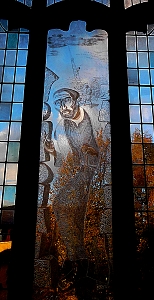
St Cedd window in Chelmsford Cathedral
The cathedral, which I will discuss later, is housed in what used to be the parish church of St Mary. The edifice is in the centre of a pleasant grassy open space. One of the buildings on the south side of this green bears a plaque commemorating Thomas Hooker (1586-1647), who was the curate and ‘Town Lecturer’ (a position established by the Puritans) of Chelmsford between 1626 and 1629.
Hooker was born in Markfield, a village in Leicestershire (www.britannica.com/biography/Thomas-Hooker) and studied at the University of Cambridge (https://connecticuthistory.org/thomas-hooker-connecticuts-founding-father/). At Cambridge, he underwent a moving religious experience that made him decide to become a preacher of the Puritan persuasion. He became a well-loved preacher, first serving the congregation of a church in Esher (Surrey) before moving to preach at St Mary’s in Chelmsford in 1626. A preacher in a neighbouring parish denounced Hooker to Archbishop Laud (1573-1645), a vehement opponent of Puritanism, and was ordered to leave his church and to denounce Puritanism, which he was unwilling to do. In 1630, Hooker was ordered to appear before The Court of High Commission. Soon, he forfeited the bond he had paid to the court and, fearing for his life, fled to The Netherlands.
In 1633, Hooker immigrated to The Massachusetts Bay Colony, where he became the pastor of a group of Puritans at New Towne (now Cambridge, Mass.). To escape the powerful influence of another Protestant leader, John Cotton (1585-1652), Hooker led a group of his followers, along with their cattle, goats, and pigs, to what was to become Hartford in what is now the State of Connecticut. They arrived there in 1636.
When Hooker and his followers reached the Connecticut Valley, it was still being governed by eight magistrates appointed by the Massachusetts General Court. In 1638, Hooker preached a sermon which argued that the people of Connecticut had the right to choose who governed them. This sermon led to the drawing up of a document called “The Fundamental Orders of Connecticut”, which served as the legal basis for the Connecticut Colony until 1662, when King Charles II granted The Connecticut Charter that established Connecticut’s legislative independence from Massachusetts. Hooker’s importance in this process has led him to be remembered as “the father of Connecticut.”
In 1914, the church of St Mary in Chelmsford, was elevated to the status of ‘cathedral’. The reason for this is slightly complex but is explained in a well-illustrated guidebook to the cathedral written by Tony Tuckwell, Peter Judd, and James Davy. In the mid-19th century, London expanded, and the size of its population grew enormously. Many previously rustic parishes that became urbanised were absorbed from the Diocese of Rochester into the Diocese of London. This resulted in a denudation of the Diocese of Rochester. To compensate for this, Rochester was given parishes in Hertfordshire and Essex. The Archbishop of Rochester lived in Danbury, Essex, which was closer to the majority of his ‘flock’ than anywhere in Kent. In 1877, the county of Essex was transferred into the new Diocese of St Albans in Hertfordshire. However, by 1907, 75% of the population of this new diocese were living in Essex. A further reorganisation led to the creation of two new dioceses, one in Suffolk and the other in Essex. After some acrimonious competition between the towns of Barking, Chelmsford, Colchester, Thaxted, Waltham Forest, West Ham, and Woodford, it was decided that Chelmsford should become the cathedral seat of the new Diocese of Essex. St Mary’s, where Hooker of Connecticut once preached in Chelmsford, became the new cathedral. In 1954, the cathedral’s dedication was extended to include St Mary the Virgin, St Peter, and St Cedd, whose simple Saxon chapel can be seen near Bradwell-on-Sea.
The cathedral, of whose existence we only became aware this year, is a wonderful place to see. Its spacious interior with beautiful painted ceilings contains not only items that date back several centuries but also a wealth of visually fascinating art works of religious significance created in both the 20th and 21st centuries. To list them all would be too lengthy for this short essay, so I will encourage you to visit the church to discover them yourself.
Having just visited Chelmsford, its cathedral, and its tasteful riverside developments, my irrational prejudice against entering the city and preferring to avoid it by using its bypass has been demolished. Although Chelmsford might not have the charm of cathedral cities such as Ely, Canterbury, Winchester, and Salisbury, it is worth making a detour to explore it if you happen to be travelling through East Anglia.
As a last word, it is curious that although there are places named Chelmsford in Massachusetts, Ontario, and New Brunswick, there does not appear to be one in Connecticut; at least I cannot find one.


 yamey
yamey 