
THE ARAL SEA which is a lake on the border between Uzbekistan and Kazakhstan was once the world’s third largest lake. From the 1960s onwards, it began to shrink because the rivers that fed it were diverted to be used for Soviet irrigation projects. Now it has shrunk to less than 10% of its original area. From the 1960s onwards, the decline of the sea’s size has been monitored by satellite imagery.
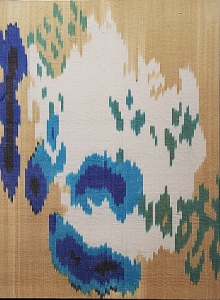
During March 2026, Vadehra art gallery has put on a temporary exhibition (at London’s Cork Street) of works by the Indian artist Himali Singh Soin and the British artist David Soin Tappeser, an artistic duo called ‘Hylozoic/Desires’. The show includes a series of images based on what can be seen of the Aral Sea in the satellite pictures that chart its decline. Their images are made of cloth woven using the traditional ikat method. Simplifying the technique, it involves weaving with threads that have been dyed in several colours in varying patterns along their length. We first saw this extremely complicated method of fabric production at Patan in Gujarat (India: see https://gujarat-travels.com/2019/02/05/weaving-in-patan/ for more about the technique). The ikat pictures at the exhibition were woven in Uzbekistan. By using this technique to capture the essence of the satellite images, the artists have produced a beautiful artistic representation of an environmental disaster that has take place over almost seven decades.
Although the ikat fabrics chart a tragic history, there is some good news. The Kazakhstan government has been able to increase the depth of the sea significantly, and as a result its salinity has dropped.
 yamey
yamey 