
The artists John Mallord Turner and Mark Rothko and abolition of slavery

AFTER BEING DISAPPOINTED by the large temporary exhibition of playful but repetitive works by the artist Sarah Lucas (born 1962) at Tate Britain, we had a coffee and then revisited the rooms containing paintings and sketches by John Mallord Turner (1775-1851). It has been many years since we last viewed these paintings, and seeing them revived our spirits after having had them somewhat lowered by the Lucas exhibition.

One of the Turner galleries contains a particularly fine painting by the American artist Mark Rothko (1903-1970). It hangs amongst a series of Turner’s often unfinished late experiments on canvas. They were mostly items found in Turner’s studio after his death. Without outlines, these almost ethereal paintings are examples of the artist’s experimentation in ways of depicting light and colour. If one did not know when these works were created, one might easily guess that they are the works of an artist working during the age of Impressionism. As an aside, many of Turner’s finished works are extremely impressionistic, and I consider him to be the pioneer of what later became Impressionism, and one of the best creators in this style. These experimental works were displayed at an exhibition in New York City at its Museum of Modern Art in 1966. That year, Rothko remarked:

“This man Turner, he learnt a lot from me”.

The Rothko painting hanging amongst the Turner experiments was created in 1950-52. Later, in 1969, Rothko donated a set of his paintings to the Tate, hoping that they would be hung close to those of Turner. They are not; they are hanging at the Tate Modern.

Moving away from the room in which the Rothko painting is hanging, I came across another Turner painting that interested me, “The Deluge”, which was first exhibited in about 1805. In the bottom right corner, Turner has painted a black-skinned man rescuing a naked white woman. On close examination, the man can be seen to have a chain around his waist. The Tate’s caption to this picture includes the following:

“Painted at a time when the cause for Britain to abolish its enslavement of people of African descent was gaining ground, this detail is significant.”

Some years after it was painted, Turner gave a print of this work to a pro-abolition Member of Parliament.

“The Deluge” is not the only painting by Turner relating to his sympathy for the abolition of slavery. His “The Slave Ship”, first exhibited in 1840, is another powerful example. This painting, now in Boston (Massachusetts), is based on the dreadful incident when, in an attempt to cheat the insurers, the captain of a slave ship, the Zong’, caused 132 slaves to be thrown overboard (in 1781).  Turner had learned about this crime from the anti-slavery activists with whom he associated. Although Turner, a liberal, was sympathetic to the abolition of slavery, he was not totally divorced from the benefits that transatlantic slavery brought to Britain, as was pointed out by Chris Hastings in the “Mail Online” on the 28th of August 2021:

“One of Britain’s greatest painters has fallen victim to woke culture, as art-lovers are being warned not to ‘idolise’ J. M. W. Turner because he once held a single share in a Jamaican business that used slave labour.”

The website of London’s Royal Academy gives more detail:

“It would be fair to assume that Turner’s views were strongly pro-abolition at the time he painted this work. However, scholars have pointed out that earlier in his career he apparently had no qualms about investing in a company that ran a plantation … In 1805 Turner invested £100 to buy a share in a business called Dry Sugar Work. Despite the name, this enterprise was a cattle farm on a Jamaican plantation run on the labour of enslaved people. The business was owned by Stephen Drew, a barrister who bought the estate from William Beckford in 1802. The firm went bust in 1808.”

Some many months ago, we saw a play at the National Theatre, “Rockets and Blue Lights” (written by Winston Pinnock). It concerns an ageing Turner seeking inspiration from a remembered incident like the awful event that took place on the “Zong”. During the play, it was alleged that because of his disgust with the slave trade, Turner gave up using sugar. Whether or not this was the case, I cannot say.

Fascinating as are abolitionist and the Rothko ‘connections’ with JMW Turner, the well-displayed paintings in the Turner galleries are all superb and well worth visiting.
The slave owner who helped abolish slavery

BLOG HOLL LATE 246

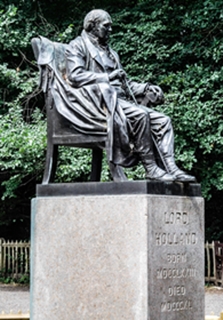
SEATED IN A CHAIR ON A STONE PLINTH, surrounded by a small pond and often with a pigeon on his head or shoulder, Henry Vassall-Fox, 3rd Baron Holland (‘Lord Holland’; 1773-1840) gazes benevolently towards the ruins of his home, which was destroyed by German bombs during WW2. The fine cast metal statue was sculpted by George Frederic Watts (1817-1914) with technical assistance from Joseph Edgar Boehm (1834-1890). I have walked past this statue innumerable times and never given it much of a thought apart from being amused when I have seen pigeons resting on the crown of Holland’s head. A friend of ours pointed out that the sculptor has included, unusually, a depiction of Holland’s wedding ring, a memorial to his marriage which was to prove very interesting with regard to his political activities. Today, the 20th of June, I walked past it yet again, but with the recent interest in statues and their subjects’ relationships with the slave trade, I wondered whether Lord Holland had any connection with it. What I have discovered is somewhat surprising.


Lord Holland was the nephew of the Whig statesman Charles James Fox (1749-1806). According to the British History Online website:
“On the death of his uncle … Lord Holland was introduced into the Cabinet as Lord Privy Seal; but the strength of the Whig portion of the Government had then departed, and the only measure worthy of notice in which his lordship co-operated after his accession to office was the Bill for the Abolition of the Slave Trade.”
This suggests that Holland was an abolitionist.


However, things are never so simple. When visiting Florence (Italy) in 1793, he fell in love with Elizabeth Vassall, wife of Sir Godfrey Webster, 4th Baronet. She and Webster divorced and then Elizabeth married Lord Holland. The “Oxford Dictionary of National Biography” (‘DNB’) records that in 1800
“… Holland assumed the additional name of Vassall to safeguard his children’s right to his wife’s West Indian fortune.”
When her first husband died in 1800, Lord Holland became the owner of the Vassall plantations in Jamaica. By accident, the abolitionist became an owner of slaves.


According to a website published by the Portobello Carnival Film Festival 2008:
“By all accounts, the Hollands were humane and improving proprietors who supported anti-slavery measures against their own financial interests. It can even be argued that he was more use to the abolitionist movement as a slave owner than he would have been as a mere politician. Nevertheless, in perhaps the defining local paradox, the finest hour of Holland House as the international salon of liberal politics was financed by the profits of slave labour.”
The site continues by pointing out that after his uncle died, Lord Holland:
“… was on the committee that framed his uncle’s bill for the abolition of the slave trade. Meanwhile Lady Holland founded the area’s multi-cultural tradition by employing Afro-Caribbean, Spanish and Italian servants – in order to enhance the foreign image of her political salon.”


VE Chancellor wrote in his article “Slave‐owner and anti‐slaver: Henry Richard Vassall Fox, 3rd Lord Holland, 1800–1840” that Holland regarded a slave:
“…not as mere chattel, but as an individual with feelings and abilities no less than those of other men …”.
However:
“… he justified the continuing history of slavery in the British Empire in Whiggish terms of the right to property and the need to obtain the consent of those who owned slaves before Abolition could be achieved…”
So, it seems that Holland, an avowed Abolitionist and ‘accidental’ owner of slaves, was placed in a difficult position. Chancellor records that the great Abolitionist William Wilberforce (1759-1833) regarded Holland as:
“… a ‘most zealous partisan’ of slave trade abolition …”,
And the DNB relates:
“Holland himself was an equally keen supporter of the abolition of slavery in 1833, despite its adverse effect on his West Indian income.”
Holland gave his full support for the Slave Trade Abolition Bill when it passed through the House of Lords. The passing of the Bill was accompanied by sizable tax relief to sugar producers in the West Indies. Lord Holland benefitted from these, as the University College London ‘Legacies of Slave Ownership’ website notes:
“Lord Holland, awarded part of the compensation for under three awards for the enslaved people on his estates in Jamaica…”
Chancellor wrote that Holland, who had benefitted financially from the tax relief concessions:
“… learnt the lesson that those called on to make sacrifices in a good cause do so the more willingly when potential loss is compensated.”


So, now returning to the statue covered with bird droppings in Holland Park, what are we to think? No doubt, Lord Holland became an owner of slaves, but by an accident caused by one of Cupid’s arrows. Had he married someone else, he might not have become the inheritor of Caribbean plantations with slaves. If William Wilberforce was happy to regard him as a bona-fide Abolitionist, that is for me a favourable contemporary character reference for Lord Holland. Some, including me, looking at his statue with hindsight, might ask why he, an avowed Abolitionist, did not emancipate his slaves as soon as they came into his possession. I am willing to believe that the answer to this is far from simple.

[For reference to Chancellor, see: https://www.tandfonline.com/d…/abs/10.1080/01440398008574816]