
WHILE WALKING ALONG a path in Holland Park, I passed a pile of sawn, short logs. The timber was not arranged tidily. It was piled up haphazardly. At first, I thought that the park workers had created this collection of wood prior to it being removed elsewhere, but then I noticed that one piece of wood had a label attached to it, which read:
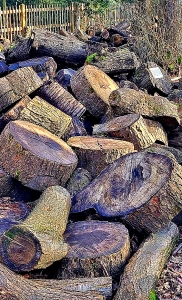
“This loggery is a habitat for invertebrates such as Britain’s largest Coleopteran, the stag beetle. The larvae live in rotting wood for up to seven years …”
So, what I thought was a temporary storage place for the sawn timber is intended to be more of a permanent feature. At other parks, I have seen collections of dead tree stumps, which are called stumperies, but this was the first time I have come across a loggery. Out of curiosity I looked up the word ‘loggery’ on the Internet, and discovered that websites concerned with wildlife conservation use the word as the notice in Holland Park states.
However, loggery has another, older meaning. It is an adjective meaning ‘rank growth’, rank meaning ‘strong’ or ‘vigorous’. The Oxford English Dictionary quotes this example of its usage in “The farming and memorandum books of Henry Best of Elmswell” by Henry Best (c1592-1645):
“When barley is loggery and full of greenes.”
Well, let us hope that the loggery in the park will allow the stag beetle larvae to achieve rank growth.
 yamey
yamey 