
WRITING IN 1931, the Spanish missionary Father Emilio noted:
“The Protestants in Munnar … appear arrogant and presumptuous and form a stark contrast to the humble pagans and submissive Catholics …”
The writer was referring to the British tea plantation owners and officials and their attitude to their Indian workers, both Hindus and those who had converted to Roman Catholicism.
31 years later, and after India had become independent, another Spanish missionary, P Fermin, observed that Munnar (in Kerala) was conceived as:
“… as a meeting centre, with pretentions of an English town, to break the routine of their [The British] plantation life on weekends. Munnar has its European club, …”
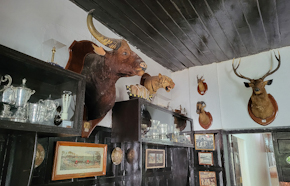
Now in 2026, the above-mentioned club, the High Range Club, still thrives, although now it is no longer exclusively for Europeans. We visited it several times in January 2026. Entering it is like stepping into the past.
The Club was established in 1909 on a large plot of land (6 acres) next to and high above a river. It was built as a residential club, and has 17 rooms. Membership is restricted to corporate planters (senior officials of the tea plantations) of the Munnar area. As the club has many affiliations with other ‘elite’ clubs in India, many of the people who make use of its facilities are members of affiliated clubs.
Not only does the club’s architecture and interior design look like a leftover of bygone Britain, but it preserves the old British club traditions and dress code rules. The Club has a wonderful old fashioned bar. Stepping into this is like going back to England of the 1930s or even earlier. Sadly, the High Range Club does not have a liquor licence.
On one of our visits to the Club, I looked at the board that listed the Club’s chairmen. From 1909 until 1973, all the chairmen had British surnames. It was only in 1974 that a chairman, Mr Murthy, had an Indian surname. And until 1966, none of the Honorary Secretaries had Indian surnames. Given this information, I wondered how many years elapsed before non-Europeans were admitted to the Club after 1947 when India became independent.
Prior to the admission of Indians, the Club, like almost all of the British colonial clubs, were places where Europeans could isolate themselves from the Indian population. Today, these clubs provide a refuge for better-off Indians, who wish to socialise amongst themselves away from the ‘madding crowds’.
The room used as the dining hall at the High Range intrigued me. At one end of it, there is a proper stage with curtains that could be used for performing plays and other entertainments. Seeing it reminded me of “A Passage to India” by EM Forster. In it he described a British colonial club and how its members performed amateur theatricals. Here at the High Range is an example of exactly what Forster described.
Visiting the High Range is not only a pleasant way to pass a few leisurely hours, but it is also a chance to glimpse into the strange world that was once a feature of British India, albeit one that enforced a racial colour bar.
 yamey
yamey 