
AFTER HAVING EATEN lunch at Munnar’s High Range Club, which I will describe at a future date, we walked along the road that runs along a bank of the Muthirappuzhayar River. As we walked along the road from the club, away from Munnar town, we spotted some graves near to the Chokanad Estate tea factory.
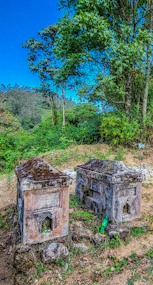
One of the graves, an elaborate enclosure painted blue, is the final resting place of I Krishnan (1932-1980). He was “factory watcher”.
There were a few other substantial, simple funerary monuments, each of which had a small niche in which a diya (oil lamp) can be placed. The other graves in this rustic graveyard are simple mounds, mostly without informative markers. All of them had been sprinkled with a white powder.
None of the graves resemble any Muslim grave that I have seen. And none of them have the crosses one would expect if they were marking burial sites of Christians.
The two names we could read in the cemetery could well be those of Hindus: Krishnan and Shanmugathai. This and the absence of any Muslim or Christian symbols made me guess that this small rural graveyard is where Hindus have been buried.
Now, before some of you tell me that Hindus are cremated, not buried, let me set you right on this. Many Hindus are cremated, but not all. There are some sects that favour burial. And if you need proof of this, visit the very large Hindu Cemetery which is close to Hosur Road in Bangalore. The Hindu graves in that cemetery are far more elaborate and colourful than those we spotted surrounded by tea plantations in the hills of Kerala.
I would like to know more about the tiny graveyard by the river. However, it might be a long time before (if ever) I find out. The place, which is about 400 yards from the nearest houses, is not even marked on maps.
 yamey
yamey 