
PARTLY DAMAGED BY the great earthquake that struck Kutch (Kachchh) in 2001, what remains of the Aina Mahal in Bhuj contains a fascinating museum. Constructed in about 1750 for Rao Lakhpatji, ruler of Kutch, the palace is named because of the many mirrors (‘aina’) contained within it. Miraculously many of these fragile items survived the earthquake. The same is true for a set of reverse glass paintings.
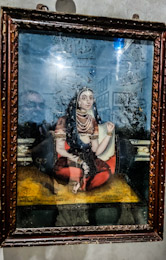
First developed in Europe, it was introduced to China by an Italian artist Giuseppe Castiglione (1688-1766). During the 18th and 19th centuries, Kutch traders brought them back from China as gifts for the rulers of Kutch. The traders commissioned them from Chinese artists, having first explained what subject matter was to be depicted. Later, glass painting became popular in both Kutch and Saurashtra, where it began to be done.
The technique of reverse glass painting is difficult. Paint is applied to the side of the glass away from the viewer. The artist must begin by painting what will be at the front of the picture. For example, if painting a portrait, the eyebrows, eyelashes, moustache, hair, and beard must be painted first. Then, the rest of the face needs to be created, and then the background. Adding to this difficulty is that the artist is painting on glass as thin as paper.
The reverse glass paintings and the ageing mirrors are but a few of the amazing exhibits on display in the Aina Mahal. We have visited the place several times, each time noticing things we had not seen before.
 yamey
yamey 