
IN 1975 I WENT to the town of Prizren in Kosovo, which was then part of the former Yugoslavia. I visited an old church in the town. Once, its internal walls had been covered with frescos. However, they had been badly defaced up to a certain height above ground level. Above that height and on the ceiling, they were intact. When the Ottoman soldiers arrived in Prizren, they used their spears to destroy the frescos, but only did so as far as they could reach. Being lazy, they did not use ladders to reach the higher parts of the church. So, the frescos beyond their reach survived.
In England, both the Dissolution of the Catholic religious establishments by Henry VIII, and later the defacement of churches by Oliver Cromwell and his followers, resulted in the destruction of many fine works of religious art. During a recent visit to Suffolk, we saw a few fine artefacts, which like the frescos in Prizren, have survived.
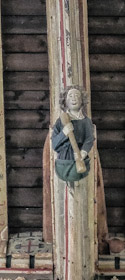
In accordance with Cromwell’s decree, many of the 15th century carved wooden angels that overlooked the nave of the parish church in Bardwell were destroyed. But, a few were left intact. Why was that? Did the workmen lose interest, or were they not paid enough? Who can say? And why was some of the 14th century stained glass left intact? Again, nobody can remember.
Over in the sleepy little town of Eye, the Parish Church contains a wooden rood screen containing beautifully painted panels that should surely have been destroyed by Cromwell’s iconoclastic vandals. Were they covered up with, say, wood panelling before the wreckers arrived, or were they removed and hidden? Luckily for us, these wonderful mediaeval paintings have survived.
Near Eye, there is a tiny church with a thatched roof in the village of Thornham Parva. It contains a rectangular wooden frame containing several mediaeval paintings that were created the 14th century. It was once the retable of an altar. Most likely, it was originally part of an altar in the Dominican Thetford Priory, which was dissolved during the reign of Henry VIII.
It is most probable that when the priory was dissolved, the retable was rescued by a Catholic family who put it in their private chapel. It passed through two other families before it was donated to the church at Thornham Parva in 1927. It is a rare surviving example of 14th century British religious painting. Interestingly, there is another series of painted panels in the Musée Cluny in Paris that resembles the Thornham Parva retable. Comparison of detailed aspects of these two sets of paintings suggests that they were both painted by the same team of artists, and were originally designed for the same location – most probably Thetford Priory.
In the space of three hours, we visited the churches at Bardwell, Eye, and Thornham Parva. All three contain artefacts of great interest and beauty which survived the religious upheavals orchestrated by Henry VIII and later by Cromwell. Once again, touring around in England has opened our eyes to its treasure house of history.
 yamey
yamey 